End of the Line: Marvel Edge

Is there a more universally reviled moment in Marvel’s history that the debut (and subsequent crash) of “Marvelution?”

For the uneducated, back when Marvel was pumping out a ton of comics and involved in all sorts of corporate level shenanigans, the powers that be decided the best way to monetize the line would be to break it into five groups.

I suppose it makes some sense in a corporate lizard type of way: why have just one interconnected, money making line of comics when you can have five, interconnected, money making lines of comics?

The groups were:

Marvel Heroes (Fantastic Four, Avengers, and Avengers related books

Spider-man (all Spider-books)

X-Men (all the X-books)

Marvel Edge (see below)

Non-Marvel Comics (Licensed books, Epic Comics, etc.)

You can see some of the problems right off the bat. Aside from the fact that expanding to five universes would expand Marvel’s line even beyond what it already was, there’s the fact that part of the appeal of Marvel is that their books are interconnected, not divided into lines.

Then there’s the matter of all those books that don’t fall neatly into any of these five groups. The New Warriors, for example, got stuck in the Spider-man group and were then forced to take in the Scarlet Spider as a member to more closely associate themselves with the other titles.

What about the Hulk? This was before the Marvel movies, before people started thinking about him as an Avenger again. Or what about Dr. Strange? He wasn’t an Avenger. He wasn’t a mutant. He had little association with Spider-man.

Marvel Edge became the catch all for titles that couldn’t be shoehorned into the other groups.

The ongoing books:

Daredevil
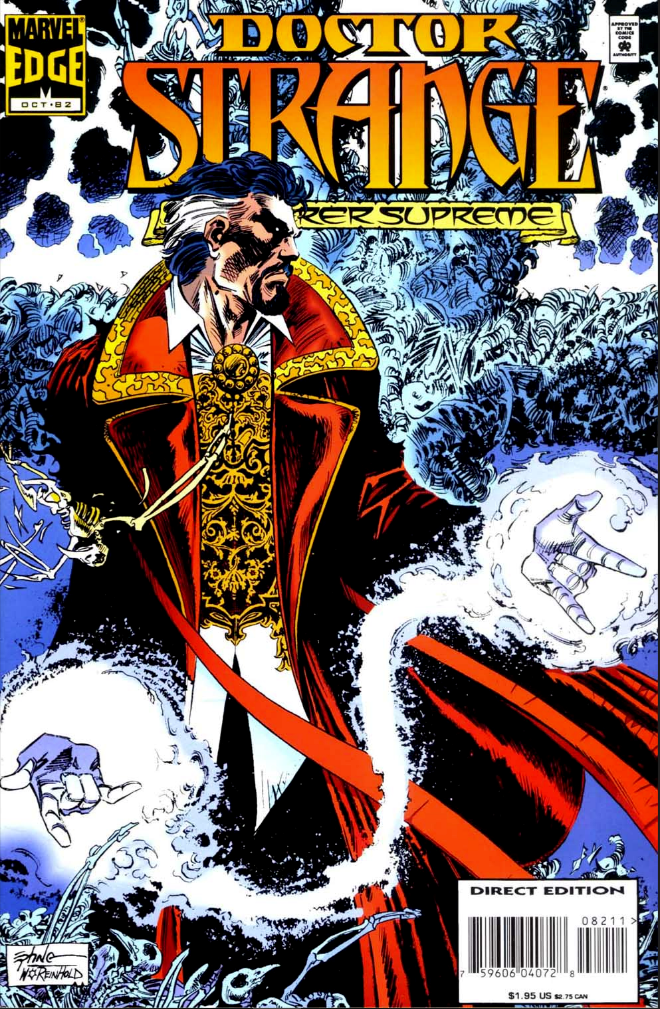
Dr. Strange
Ghost Rider
The Punisher
The Hulk

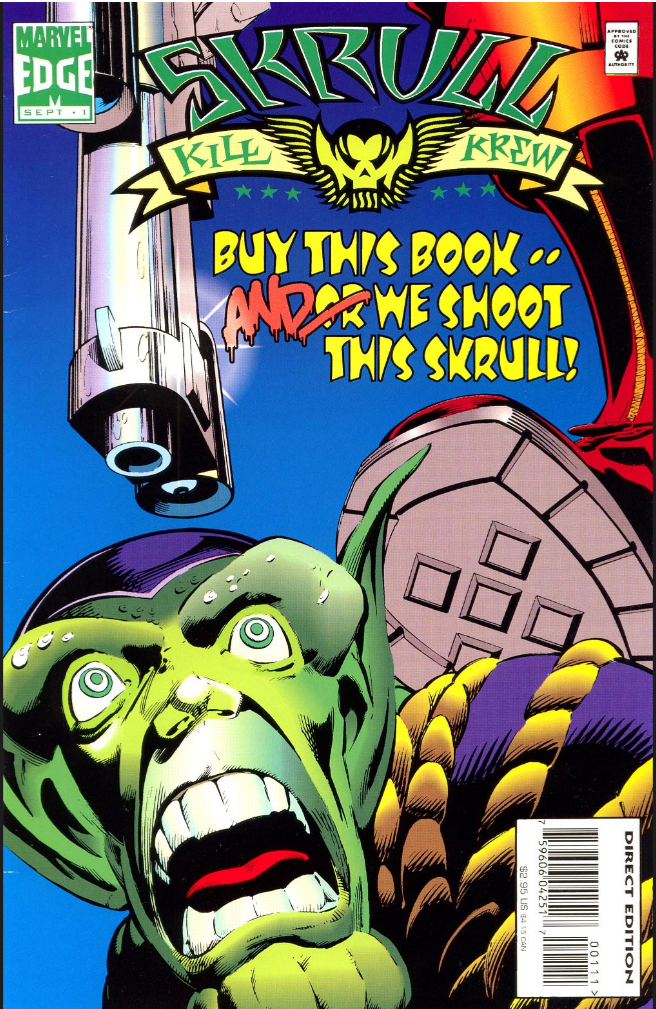
There were also a handful of limited series spinning out of those titles, including the first Skrull Kill Krew series. There as also a monthly book called “Over the Edge” that rotated characters each month. It was part of Marvel’s 99 cents line made to attract new readers and offer something for those who had been priced out of regularly Marvel titles.
You might be able to connect the dots on the first four titles in that list above — you’ve got the street level characters in Daredevil, the Punisher, and Ghost Rider. And Dr. Strange regularly operates in the same space as Ghost Rider. But how does the Hulk end up in that group?

Since Marvel Edge is a new line entirely and not just a clear definition for a group of books (ala the X-books or Spider-books), it started the way you would expect: with a crossover event.

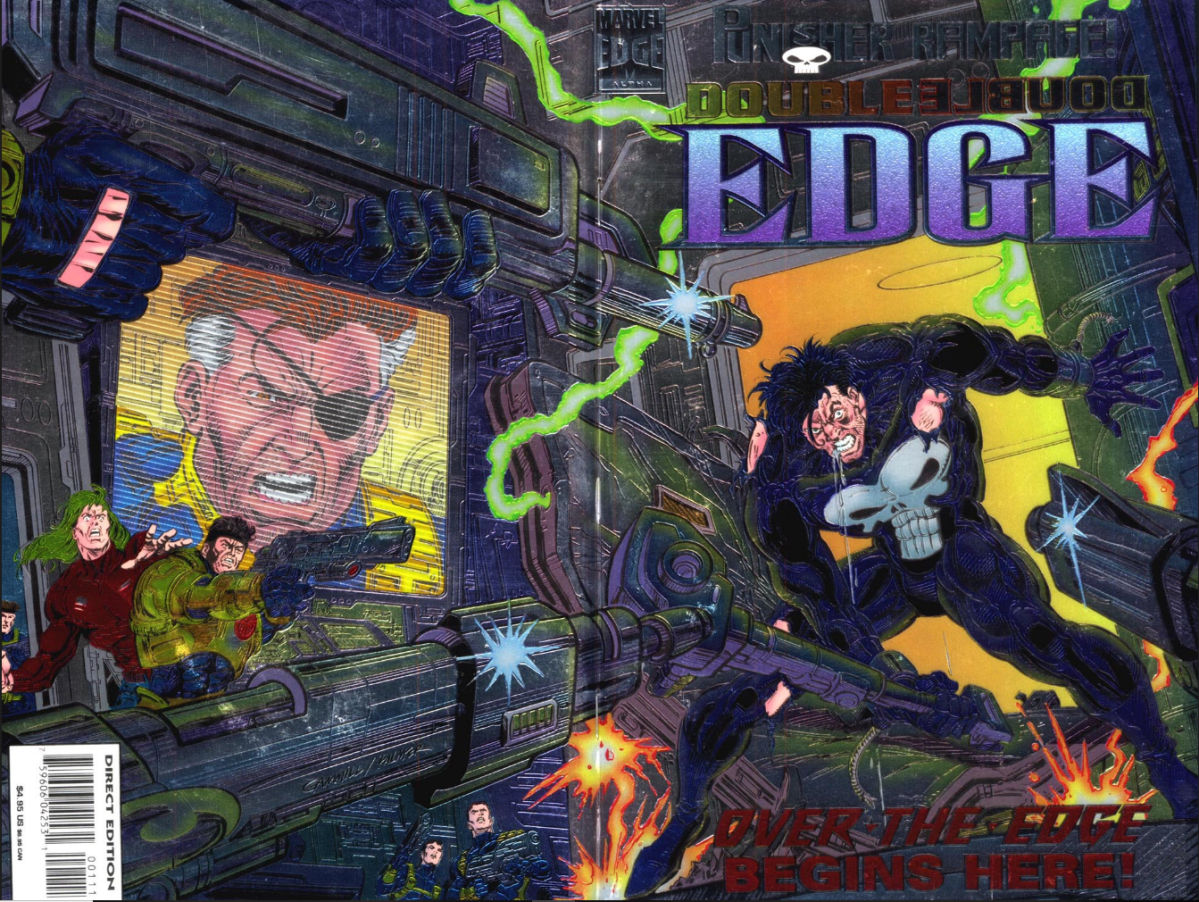
It’s called “Over the Edge” and it starts exactly how you would expect, with a double sized, chromium cover special called “Double Edge Alpha.” It would then continue in an issue of the other main books (not including The Punisher, as his series had ended, but he would get a new one stemming from this event) and finally ending in, you guessed it, “Double Edge Omega.”

If you judged the line simply by this crossover (which, to be honest, I did) you would think Marvel Edge is horrible. Many of these issues barely connect with the story in part because these characters just don’t operate in the same space. Not only that, but the story itself is too thin to support this many issues.
Basically, SHIELD captures The Punisher, who is then brainwashed by a rogue agent to be believe that his family was killed by Nick Fury. The Punisher breaks free and begins hunting down Fury and anyone close to him.

Using SHIELD as the framing device for this crossover is a strange move given that none of these characters have much of a connection with that organization. There had to have been a better thread to weave throughout these books, but maybe this was a testing ground for a future SHIELD series.

Regardless, the event ends with The Punisher killing Fury and being sentenced to death.

Dedicating the first month of the line to a crossover seems like a good idea until you realize that the line only lasts 8 months. Any connective tissue formed in that initial story didn’t last very long.

The fact that Marvel Edge only covers 8 months does, however, make it easy to go back and read every issue with the Edge logo on it.

Some highlights from the line:

  • Salvador Larocca’s art on Ghost Rider is great. He’d really started to develop his own style on this run.
  • Ron Garney’s art on Daredevil is also great. Garney is one of the most underappreciated artists working. He’s assisted by some nice stories from JM DeMatties, although I will admit that DeMatties goes a little overboard on the captions.
  • Mark Buckingham on Dr. Strange is great, too. But he’s saddled with some uninspiring stories by a number of different writers.
  • The new Punisher series is pretty fantastic. The gist of the story is that Frank’s execution was faked by a mob boss who wants him to take over his crime family. Seeing Frank compromise his rather ridiculous black and white view of the world is a lot of fun, even if he does resort to wearing his costume way, way too much. It’s written by John Ostrander, so no surprise as to the quality. It’s mostly drawn by Tom Lyle.
  • Angel Medina takes over on art on the Hulk and I’ve always enjoyed his work. He’s a great fit for the Hulk.

There are, of course, some low lights, too.

  • The Hulk series is treading water. It seems like Peter David is just trying to come up with new variations on the traditional Hulk, which worked for the first bunch of years he was on the book, but at this point feels like grasping at straws.
  • Dr. Strange and Ghost Rider are fairly boring, art notwithstanding.
  • The Typhoid Mary limited series is bad. It’s really bad.
  • The Skull Kill Krew limited series does not hold up at all and, if anything, is borderline offensive. The idea that a race of creatures are considered universally evil and deserving of the death penalty is a horrible, horrible take, and the characters are incredibly unlikable.

In the end, having a shared corner of the universe for the “street level” and supernatural characters in the Marvel universe is a solid idea, but the characters chosen were hard to connect. With stronger creative teams and a more focused reason for the books to be connecting, this is something that could actually be pretty good.


Here’s the actual problem with the Marvel movies – and it came from the comics

Just like with the comics, the Marvel movies thrive on being connected, and they wither without it

At a certain point, comic book readers became obsessed with stories that “count.” Basically, these are stories that impact continuity in some way, stories that are important to the larger connected universe.

Comics that weren’t an active part of the shared reality died on the vine and self-contained stories went the way of the dodo. Readers bought books specifically because they believed there were connections to other books. This has gone on for decades in comics, but had never really been done in movies.

This is why the Marvel movies took off like they did.

The idea of a bigger, expansive narrative existed from the start.

Perhaps more importantly, the objectives of these larger narratives were made very clear from the start.

The initial narrative was the formation of the Avengers, a through line that included every phase one movie. In phase two, it was Thanos and the Infinity Stones. Phase three was bringing everything together.

Marvel also made sure any new characters that weren’t directly connected to the overreaching arcs were introduced in movies the audience already knew, or at least incorporated characters they already knew.

Ultimately, it made every movie seem like it mattered in the grand scheme.

I’m not sure anyone knows what the current grand scheme of the Marvel movies is.

Is it the multiverse? Or Kang? Because the Black Widow, Eternals, and Shang-Chi didn’t appear to have any connection to either of those things. Neither, really, did Thor: Love and Thunder, or Black Panther: Wakanda Forever.

It’s not surprising that the two movies in phase four that deal with the multiverse (Spider-man and Doctor Strange) also featured the most connections with the larger MCU. But that’s just 2 movies out of 7 that featured what has become the essence of Marvel movies.

The main motivation to see these movies in theater has disappeared, and with the advent of Disney+, an awful lot of people are perfectly happy to wait a few months to see Marvel movies from the comfort of their homes.

It hasn’t gotten much better in phase five. While Ant-man and Wasp prominently featured Kang, it wasn’t the Kang who will supposedly be the big bad of the current overarching story. In fact, nothing about the movie set Kang (any version of him) up as a reoccurring character that the audience should be excited about.

Thanos’ impact was felt well before he properly appeared in a movie. The attack on New York that brought the Avengers together was caused by Thanos. Ronan the Accuser worked with Thanos.

What has Kang done? Why would anyone consider him to be an epic threat, let alone a reason to go to the movies?

Guardians of the Galaxy had the strength of its franchise on its side and it was also dealing with the fallout from phase three; even taking place in its own space, the movie was still connected to the large universe.

The Marvels’ connections are strongest with the Disney+ shows. If the goal is to get people to go to the theaters instead of waiting for the release on Disney+, maybe strongly connecting it to two shows on Disney+ wasn’t the best idea.

The upcoming slate of movies doesn’t look much better. Deadpool should do well because it’s long stood on its own, even if it didn’t feature Wolverine. But Captain America: Brave New World? Did anything about the Winter Soldier/Falcon show suggest that the multiverse or Kang would be part of Cap’s world? The same goes for Thunderbolts and Blade.

Thunderbolts is particularly strange because it suggests an entirely separate overarching story running through Black Widow and some of the Disney+ shows — possibly Captain America. But, again, will people think those movies count if they’re not dealing with the big story?

And does anyone actually know what that is yet?

Just as with the comics, it’s a shame to see it come to this. It’s unfortunate that people aren’t interested in stand alone stories, but in their defense they’ve been trained to expect as much from Marvel movies, so not getting it is a disappointment.

If Marvel wants to continue to expand their cinematic universe, they need to determine whether or not they can maintain separate lines within the larger structure. The existence of the Thunderbolts movie would suggest that are going to give that a try, but, again, we’re 10 movies post-Infinity Wars and it’s still not clear what the plan is.

I suppose the upside of movies is that they’re limited by real people, so we don’t have to worry about Marvel releasing a dozen X-men movies every year.

They’re totally going to do that now, aren’t they?

Squadron Supreme is better than Watchmen

Squadron Supreme is a often ignored classic.

It was a groundbreaking superhero story.  It took archetypal characters to their organic extremes.  Every action had consequences.  Change was real and long lasting.  These were sophisticated stories featuring complex moral and philosophical issues, told through the genre of brightly colored super beings.

It wasn’t Watchmen.

The comic in question was The Squadron Supreme, a 12 issue limited series written by Mark Gruenwald with pencils by Bob Hall, John Buscema, and Paul Ryan, and inks by an all star cast.  It debuted in September of 1985, a full year before Watchmen.  There are a lot people (including me), who consider it an unsung classic, deserving of the type of recognition that Watchmen gets.  So why is it overlooked?

A Brief History of the Squadron Supreme

The Squadron Supreme were created by Roy Thomas and John Buscema, although it would be fair to say they were actually created by Thomas and John’s brother, Sal.  See, the Squadron first appeared in Avengers #85 in 1971 as good versions of a team that Thomas and Sal had introduced just two years earlier in Avengers #69: the Squadron Sinister.  Each team had the same four members (although the Supreme version had an additional four), but they weren’t the same.  One was bad, one was good.

If you’re confused by that, you’re not alone.  Even Marvel’s own production office couldn’t keep the two teams straight, advertising the “Squadron Sinister” on the covers of two issues of the Avengers that actually featured the Squadron Supreme.

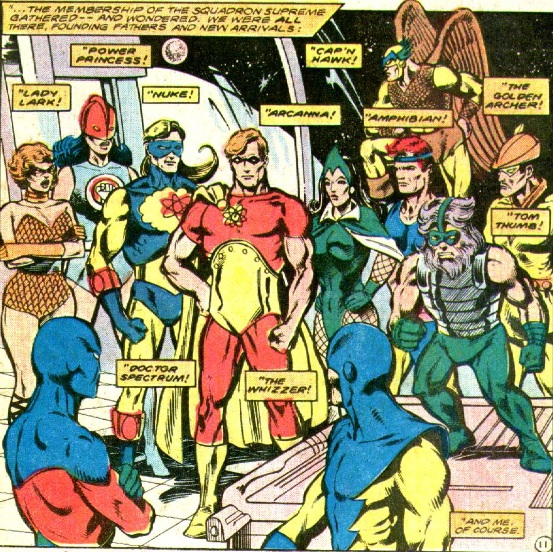
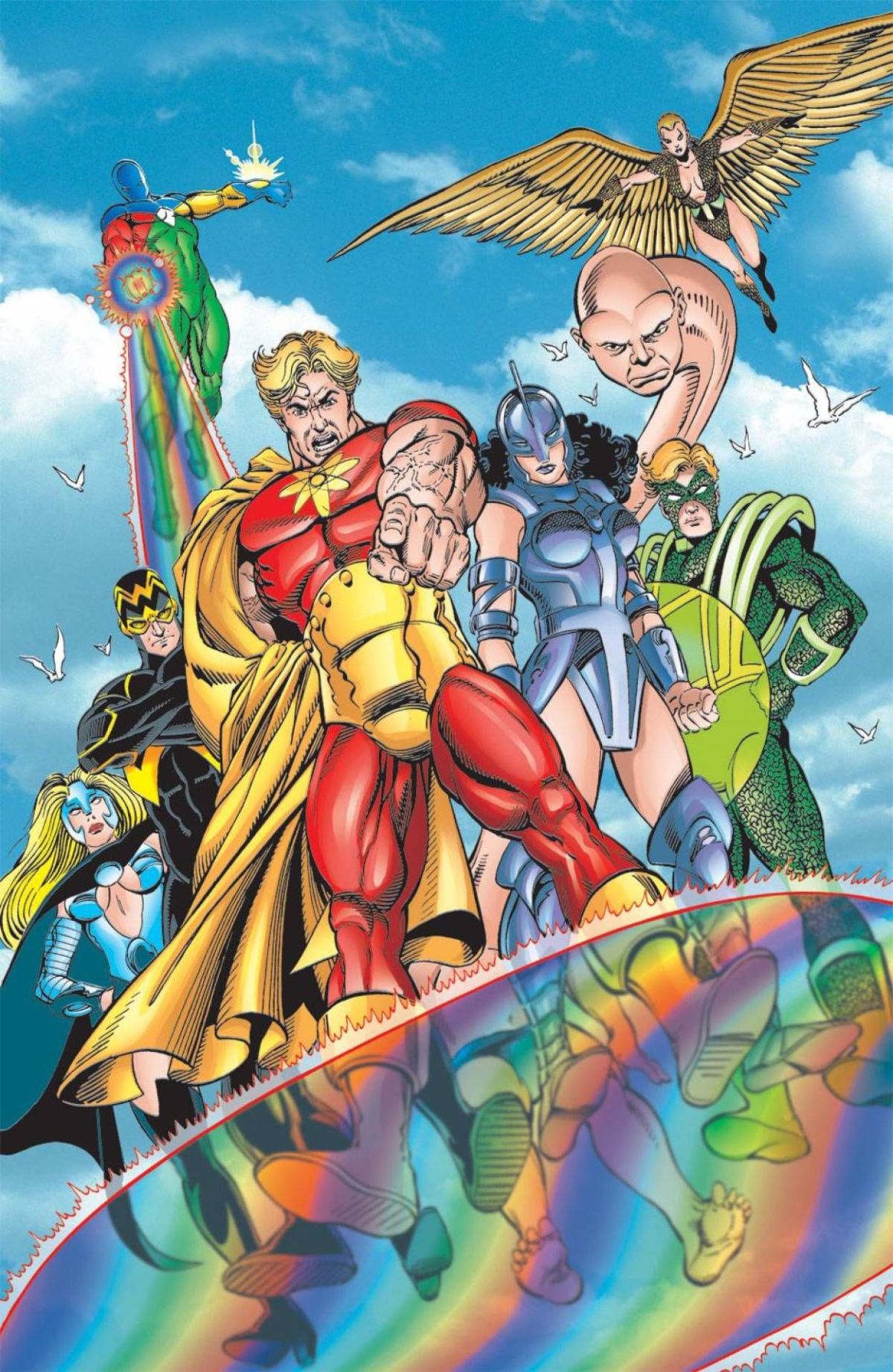
Anyway, both teams were created as analogs for DC’s Justice League of America.  The common members of the two Squadrons were Hyperion (Superman), Nighthawk (Batman), Whizzer (the Flash), and Doctor Spectrum (Green Lantern).  When the Squadron Supreme first appeared, their line-up also included Lady Lark (Black Canary), a different character named Hawkeye who would later go by Golden Archer (Green Arrow), Tom Thumb (the Atom) and Cap’N Hawk (Hawkman).  It’s kind of interesting that those were the additions, as opposed to versions of the remaining Justice League founders (Wonder Woman, Aquaman, and Martian Manhunter).

The Squadron Supreme would make a few more appearances in the Avengers, as well as showing up in an issue of Thor and Spider-man.  But their big story line would come with an extended arc in the Defenders.  The ranks of the team would fill out here as well, with the additions of Power Princess (Wonder Woman), Amphibian (Aquaman), Arcana (Zatanna), and Nuke (Firestorm).  Missing from the ranks is the Skrullian Skymaster (the Martian Manhunter) who would be briefly shown as a founding member in the first issue of the Squadron Supreme series, but would only be revealed in the Squadron’s entry in the Marvel Handbook (at least until the follow-up to the follow-up of the Squadron’s series).

Now, a word about Nighthawk.  Nighthawk is Kyle Richmond.  On our world (the 616 Earth of the Marvel U), he was a Defender.  But here’s the thing: the Defender known as Nighthawk wasn’t actually of our world!  He was, in fact, the Nighthawk from the Squadron Sinister who switched sides and ended up joining the Defenders!

I know, right?

But it’s the Squadron SUPREME’s Nighthawk that is important.  In the Squadron’s next appearance, Kyle Richmond had become president of the United States of the Squadron’s world.  He was soon taken over by the Overmind, who used Richmond to turn the U.S. into a paranoid police state.  The Overmind himself was under the influence of Null the Living Darkness, but that’s neither here nor there.  The important bit is that the Overmind also took over the Squadron.  The Defenders managed to free the Squadron and together they defeated Null.

And that was it.

Because No One Demanded It

In the sixteen years since the Squadron Sinister first appeared, the Squadron Supreme had only made a handful of appearances in the Marvel U, none of which had any lasting impact.  It’s hard to imagine there was much of a fan movement to get them their own series.

There also wasn’t much from the Defenders story that would suggest a Squadron Supreme story needed to be told.  They’d been taken over by a supervillain, but what superhero hasn’t?  But if there was a core idea behind the Squadron’s series, it was to extrapolate the bigger picture from something small.  Gruenwald took the germ of the Defenders story and turned it into a virus.  The Squadron had been controlled by the Overmind for quite some time, and they’d been busy.  They’d helped to build the United States into a fascist country that then spread across the globe by invading and occupying the rest of the world.

But then the Overmind went away and oppressive order turned into complete chaos.  The world hadn’t actually ended, but the Squadron Supreme’s earth was about as post-apocalyptic as you could get.

With the world in shambles, the Squadron Supreme decided to get proactive.

But this isn’t The Authority style proactive.  No, the Squadron decides to set themselves up as a super power.  Federal governments remain, but in reality everyone answers to the Squadron.  The Utopia Project initially focuses on feeding the world, building homes, bolstering the economy, and dismantling the military.  After all, what good are stealth bombers or even nuclear bombs when you’ve got Hyperion, the stand in for Superman running around?

In a world full of superheroes, there are always supervillains, they always seem to escape from whatever prison they’re locked in.  So to break this endless cycle, the Squadron Supreme come up with the Behavior Modification Process.  Basically, it’s a machine that changes a person’s mind, removing their criminal impulses and replacing them with a desire to do good.  Before Zatanna, Dr. Strange, and Nick Fury began mind wiping, the Squadron Supreme was altering people’s brains.

And then they got rid of death, or at least created world wide system to put people into deep freeze until they could be cured or brought back.

Not every member of the Squadron is on board with their program, though.  Nighthawk leaves the team from the start, determined to find a way to stop is former compatriots from ostensibly taking over the world, even if they have the best intentions.  He argues that they should be helping humanity, not commanding it.

The series ultimately follows two narratives: The Squadron’s efforts to create a Utopia and Nighthawk’s plans to oppose them.  The two story lines come to a head in the finale which was, at the time, one of the most brutal comics I’d ever read.

Name a political issue and there’s a reasonable chance the Squadron Supreme limited series dealt with it.  And each issue featured actual change, be it a new development in the Squadron’s plans, the death of a character, or the escalation of a moral dilemma.  This was a big time ideological battle taking place in the pages of a superhero comic.  It may have lacked the subtlety of a certain other 80s comic that rewrote the rules of superheroes, but it was just as deep.

I’m not doing the series justice, in large part because this lacks context.  Superhero stories like this just didn’t exist back in 1985, even though they would become all the rage after Watchmen was released.  But the Squadron Supreme series came first, yet isn’t showing up on a Time magazine list any time soon.

The Watchmen Factor

The thematic similarities between the two series are striking.

Both books feature superheroes taken to their extreme ends.  In the case of Watchmen, it’s breaking them down to the fragile human beings that they really are.  As many of said, it’s a deconstruction of not just the characters, but the genre.  If anything, Squadron Supreme is pumping the characters full of steroids, taking the idea of superheroes to the other end of the spectrum, where they place themselves above the rest of the world.  In Watchmen, they are down in the gutters with the rest of us, manipulating events in the background.  In Squadron Supreme, they are overt, taking over the country and forcing their will upon us.

These behaviors carry over to the way the story is told.  Both comics feature secret plots to prevent horrible events from happening, but in Watchmen those plans are kept secret from both the characters and the reader; we only as much as they do.  In Squadron Supreme, we see it all.  Nothing is hidden.  And why would it be?  It’s the actions that are important, so we need to see them, as opposed to Watchmen where the driving force is the mystery.  If we had all the information in Watchmen, it would lose momentum.

Even these secret plans are set opposite each other.  Ozymandias’ goal is to prevent the world from falling into chaos brought by a third World War, a nuclear World War.  Nighthawk’s goal is to prevent the world from becoming imprisoned by the extreme order brought by the Squadron Supreme.  The beginnings are the same way.  When Watchmen opens, there’s a certain status quo, one that involves all (but one) vigilante having retired and Richard Nixon serving yet another term as president.  The death of Comedian up ends all of that, introduces chaos into the equation, chaos that eventually pushes the world to the brink of WWIII.  In Squadron Supreme, the world has already fallen into chaos, but the Squadron Supreme decides to create order.

It’s also interesting to note that both books deal with analogs of other characters.  Moore wanted to use the Charlton superheroes, but was famously told to create new characters instead.  Moore wanted to use recognizable characters so that the opening had some emotional resonance.  DC obviously didn’t want to ruin their newly acquired IPs.  It was an odd decision, though, given that Watchmen doesn’t take place in the mainstream DCU, or even on an alternate Earth, as by this point DC had done away with such things.  Captain Atom, Blue Beetle, et al. would have been perfectly fine in the DCU even if Moore had used them.

The fact that Watchmen took place in its own reality, set aside from the DCU, at a time when DC had gotten rid of alternate realities, increased the profile of the book.  This must be something special if DC were willing to create a superhero book that was completely removed from the rest of their line.

By that same token, Squadron Supreme was firmly entrenched in the mainstream Marvel U, even if the series took place on an alternate Earth.  It had roots in the Avengers.  It was seen as just another Marvel comic.

 Opposite Ends of the (Doctor) Specturm

Ultimately, the Squadron Supreme and Watchmen are as different at the two men who wrote them, Mark Gruenwald and Alan Moore.

By the time Squadron Supreme debuted, Mark Gruenwald had been working for Marvel for 7 years.  He was initially hired as an assistant editor and had moved up the ranks quickly.  He was perhaps best known as the editor of the Avengers line of comics, although he would later become synonymous with Captain America, a title he wrote for 10 years.  Gruenwald’s run on Cap would feature incredible highs (everything leading up to #350, really) and incredible lows (the newly returned Captain America armor, for example), but the length and depth of his time on the book would ultimately make him one of Captain America’s premiere creators.

Gruenwald wrote superhero stories.  He edited superhero stories.  He was known as the guy who knew every piece of obscure continuity in the Marvel universe.

Leading up to Watchmen, Alan Moore had made a name for himself in the U.S. with his impressive run on Swamp Thing.  He’d also penned the classic Superman stories “For the Man Who Has Everything” and “What Ever Happened to the Man of Tomorrow?” but the bulk of his work had been on a sophisticated horror title that had parted ways with the Comics Code Authority and would eventually be labeled “Suggested For Mature Readers.”

To say that Moore was coming at Watchmen from a different direction than Gruenwald was approaching Squadron Supreme is an understatement.

The two publishers were in very different places as well.  Marvel was being run by Jim Shooter, who had hammered the company into a well oiled machine of family friendly superhero fare.  Marvel wasn’t in the habit of taking risks at this point in its history. The fact that the Squadron Supreme even happened was impressive, but the fact that it took place in an alternate reality made that possible.

DC, on the other hand, was being run by Jenette Kahn, who had already broken new ground with Frank Miller’s Ronin and the Dark Knight Returns, not to mention the new direction Moore had taken Swamp Thing.  Post-Crisis on Infinite Earths, DC seemed focused on publishing a variety of content that appealed to a wide range of ages.

So when DC, hot on the heels of The Dark Knight Returns, announces that the guy who rejuvenated Swamp Thing would be releasing a brand new limited series that was meant for mature readers, people take notice.  The same could not be said for the guy who writes Captain America releasing a new series starring minor characters from an old Avengers story line.

Squadron Supreme is pure superhero story and embraces those elements; everyone runs around in spandex and capes like it’s perfectly natural.  There are big, bombastic battles.   No one will ever think this is anything other than a superhero comic, even if it’s a truly phenomenal one.

Watchmen simply has some superhero dressing.  It’s not the story of supremely powerful beings living among us.  It’s the story of regular humans doing insane things for a variety of reasons.  It’s just as much a murder mystery and political thriller as it is a superhero story.  It’s science fiction.  Watchmen stands out from the metric ton of superhero comics being published by the Big Two every month.

Watchmen made its characters less super; Squadron Supreme made them more.  They appear to be diametrically opposed, yet did so much to change the way superhero stories are told.

The Post-Gruenwald Era

After the Squadron Supreme limited series, Gruenwald and artists Paul Ryan and Al Williamson abused the Squadron some more with the “Death of  Universe” OGN.  This particular adventure took place in space, and somehow on their return trip, the Squadron ended up in the mainstream Marvel U.  They kicked around for a bit before the Avengers finally sent them home.  Sadly, they returned to a very 90s universe in “New World Order.”  They would eventually appear again in the Exiles series.

There was also an attempt at creating another version of the team, spear headed by J. Michael Straczynski.  The goal, it seemed, was to make them more realistic.  It didn’t turn out too well.

The team’s highest profile member is Hyperion, would play a major role in Jonathan Hickman’s Avengers run, although Hickman has stated that this is yet another version of Hyperion and not the “Gruenwald version,” as he called it. That’s unfortunate, as this Hyperion is the only survivor of a destroyed Earth, and there’s a part of me that would like to see the Squadron’s earth wrapped up for fear of anyone doing any more harm to the team.

But the original Hyperion did eventually pop up, part of the fall out from Secret Wars. A new team is formed consisting of characters who have lost their alternate realities. The concept in and of itself is fine, but the series was uninspired and ended after less than two years.

The Squadron Supreme had their moment to shine in a complex, epic limited series.  If you love superheroes, you owe it to yourself to track down this truly groundbreaking run.

The Ewingverse Avengers, Part 3: Ultimates

A look at the Marvel comics of Al Ewing, part 1

A look at the Marvel comics of Al Ewing, part 2

Ultimate

We saw in New Avengers where White Tiger and Power Man ended up after Mighty Avengers, but what about the rest of the team? Well, Blue Marvel and Spectrum join the Ultimates, the first version of this team to exist in the mainstream Marvel U.

They are joined by Captain Marvel, Black Panther, and Miss America.

They are meant to be a team that solves the big problems, that are proactive, that tackle the problems that require the smartest, best thinkers and those with experience dealing with crazy.

It’s a fantastic line-up and one that stays more or less intact throughout this run and the one that follows. I would have loved to have seen occasional guest star the new Giant Man join in some capacity and it seems like Ewing was headed in that direction, but we never get there.

The book is firmly rooted in the cosmic side of the Marvel U, which is really the final step in Ewing’s story. We’ve now gone from the community rooted Mighty Avengers to the global superheroes of the New/U.S. Avengers, and now to the universe spanning (and beyond) adventures of the Ultimates. It’s a great evolution and showcases Ewing’s abilities to write at any level.

The Ultimates are put together by Captain Marvel to fix big problems and they start off with one of the biggest: Galactus. Ewing’s take on Galactus is great. He fleshes out his origin, gives his existence context within the greater Marvel cosmic universe, and then does the unthinkable: makes him a force for good.

The ideas and adventures in the Ultimates stand side by side with some of the best 70s Marvel stories, which is probably the biggest compliment I could give the series.

The first six issue comprise an epic story centered around Galactus, but that spans well past him. We also learn very quickly that with all these long standing Marvel heavy hitters, Miss America is perhaps the most important.

The back half of this twelve issue series features an apparent inevitability for Ewing: a crossover. However, this could be the finest work Ewing has done incorporating an event into one of his books. Captain Marvel plays a pivotal role in Civil War II and Ewing takes full advantage of that, doing a better job with her character than the main series does.

It’s easy to see how the team would fall apart during Civil War II. Captain Marvel wants to be proactive to the point of arresting people before they commit crimes. That’s not something Black Panther would ever be able to stand for. The division doesn’t even split the team in half so much as put everyone at odds with Captain Marvel.

The first series ends with the team going their separate ways.

Squared

Ewing has made a lot of deep dives into Marvel history over the course of his many Avengers books, but he saves the deepest dive for his final story.

Ultimates 2 (although made to look like Ultimates Squared) starts with the band getting back together. While Captain Marvel is trying to patch things up on her own, Miss America has already decided they need to be a team again because they have a job to do.

Miss America has never been as fully utilized as she is in the Ultimates. Her power levels are off the charts and we get enough information about her past to know that she has more experience dealing with inter-dimensional cosmic insanity than that rest of the Ultimates combined. Ewing only gives us hints as to what her life has been like, hints that would turn into one hell of a comic if they were ever dug into.

The deep dive comes in the form of the Troubleshooters, a group made up of new versions of New Universe characters. For those of us who read New Universe books during our early comic book reading days, this is wonderful. The new versions aren’t echoes of what came before, but fully realized alternate manifestations with their own fascinating back story.

And just to keep the other universe feel, Ewing even brings back the original Ultimates, the ones who had just been erased during Secret Wars.

I’m not sure if bringing back the Ultimate was always a part of Ewing’s plans or if he felt the need to include them given that the final issue of Ultimates 2 is renumbered as #100, not #10, so as to include every issue of the Ultimate universe runs as well. It’s a thin connection even with the original team making an appearance.

It’s The Maker who brings back the original Ultimates, which makes perfect sense since he’s been the major villain since New Avengers. Blue Marvel’s history also plays a big part in getting us to the finale. Honestly, the only thing missing is the Plunderer.

It’s a perfect finale for his run, the perfect ceiling to a room he built from the ground up.

It’s just a shame that there was a ceiling at all.

The Ewingverse Avengers, Part 1: The Mighty

Starting with The Mighty Avengers, Al Ewing strung together a series of great Avengers books

Al Ewing should write the New Warriors.

Ewing excels at touching multiple corners of the Marvel U in a single series, something that hasn’t been done well for an extended period of time since the original run of the New Warriors. While I might focus on the Mighty Avengers being a ground level team of heroes, the kind who are focused on fighting in the streets and in their communities, Ewing never limits the series because of that.

There are too many toys in the Marvel U to just stick with  any one area.

There was a period after Jonathan Hickman left and before Jason Aaron took over that the Avengers books lacked focus. There were a bunch of new series introduced during this time, most of them short lived, all of them bogged down by line wide events. In Marvel’s defense, they appeared to be trying a lot of different angles, yet never gave the books enough time to find fans.

Writer Al Ewing was perhaps the creator who was trapped in this quicksand the longest, losing the most titles to boot.

Consider: Ewing’s run began with Avengers fighting Plunder and ended with the Avengers facing the First Firmament, the first universe to ever exist. That’s some impressive escalation.

Ewing ultimately worked on what were ostensibly three different teams of Avengers, each connected to the other, each tonally very different. If you think of it in terms of scope, each was a different level, each series getting progressively larger than the last. Taken as a whole they paint a really interesting picture, one that spans over 75 issues.

Mighty Avengers

The most glaring omission from the Hickman era is the Bendis era stalwart Luke Cage. It’s understandable, though, as Luke is a larger than life character who deserves screen time, and Hickman’s epic was already fairly bloated with characters. Better, then, to give Luke his own team that’s more in line with what he wants to do.

And what he wants to do is make a difference in the lives of regular people.

He’s joined initially by the new Power Man and the latest White Tiger, both of whom were most recently seen in Daredevil, a book that takes place on the streets of New York, not in outer space. They’re a good addition given what this team is looking to do.

They’re joined by Spider-man, in this case the Superior Spider-man, Dr. Octopus in Peter Parker’s body.

One of the unfortunate hallmarks of Ewing’s time on the Avengers is being laden with invasive continuity. This usually comes in the form of events, but in this case it’s having to deal with a dickish Spider-man. It’s not great, particularly if you consider how great Spider-man could have been with this group.

That said, an event is what ultimately brings the team together. The Infinity crossover has the main Avengers teams off world as Thanos and his Black Order launch an attack.

The team comes together to fill the void. Joining Cage, Power Man, White Tiger, and Spider-man are Spectrum (formerly Photon formerly Captain Marvel), Blue Marvel, and…Spider Hero. Yes, Spider Hero is ridiculous, but there’s a story reason for it. This is also a perfect example of how great the real Spider-man would have been on this team. Peter Parker’s wit regarding his replacement would have been delightful.

She-Hulk and Falcon eventually join the team as the series progresses, although neither gets the kind of time that the core group gets. This book is really about Cage, Power Man, White Tiger, Spectrum, and Blue Marvel, with Spider Hero supplying some heavy lifting with plot.

So while the Mighty Avengers become a rallying point for the people of New York City when Thanos’ Black Order attacks, the battle is quickly followed by a 70s style supernatural adventure (that’s a hint as to who Spider Hero really is). Ewing also pulls stories from the characters’ pasts, particularly White Tiger and Blue Marvel.

Ewing digs into everyone’s pasts to make their presents more substantial.

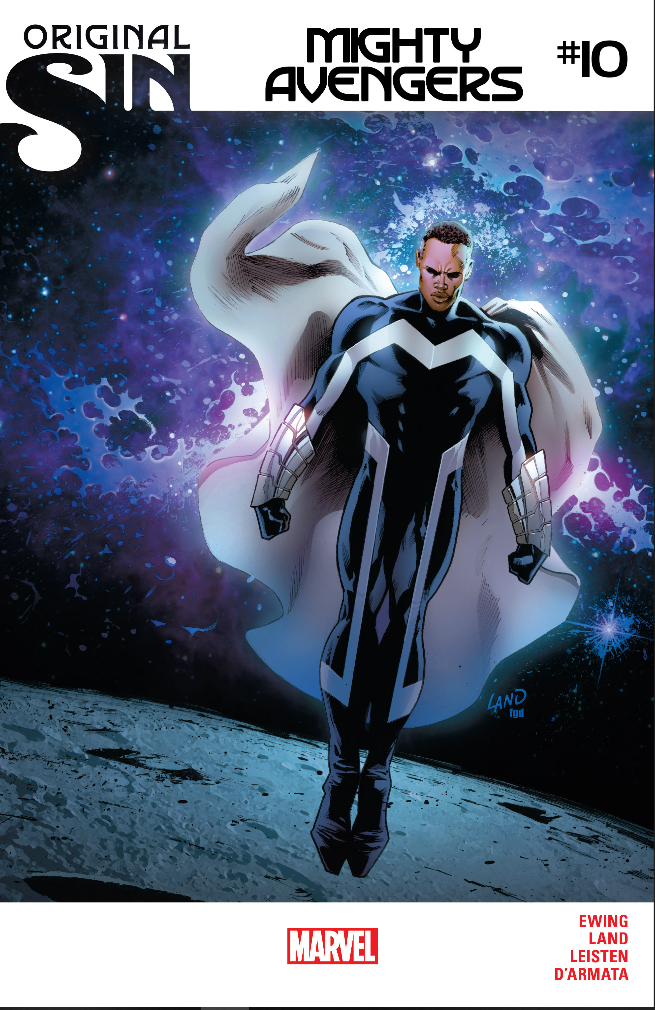
In particular, Ewing takes Blue Marvel to the next level, helping him become what should have been a prominent player in the Marvel U. He should be Marvel’s Superman. Marvel should fully embrace that. But no one else seems willing to even touch him.

Over 14 issues, Mighty Avengers is pulled into three Marvel events, Infinity, Inhumanity (barely), and Original Sin. Ewing and company make the best of what they’re given, but it clearly didn’t help sales enough to keep the book afloat.

But you can’t keep a good concept down, so after Mighty Avengers ends, Captain America and the Mighty Avengers begins.

Captain America and the Mighty Avengers

The concept that threads through the two books is that of a community outreach program. The Mighty Avengers considers anyone who is willing to help a member. They have a hotline set up and tips come in from around the city.  The Mighty Avengers aren’t just there to help the every day person, they’re there to empower them.

Unfortunately, the second series starts off much like the first in that it’s burdened with another crossover. This time it’s Axis and it’s much worse on the title than any crossovers before. Good guys are acting like bad guys now and the focus of this new title, Sam Wilson, the new Captain America, is starting his tenure as a bad guy.

It’s not great and it undermines the book from the very start.

Cage is also seemingly under the influence, although that leads into a bigger story involving the Beyond Corporation and a welcome change to Spectrum.

The Beyond Corporation is the big bad of the 9 issues of this series, but bare in mind that the first three issues are entangled in Axis and the last two are part of the “Last Days” lead up to Secret Wars. For those who are counting, that leaves four whole issues that Captain America and the Mighty Avengers are free to do whatever they want.

If you’ve been reading good comics over the last few years, you might recognize the name “Beyond Corporation” from the fantastic comic called Nextwave. One of the sticking points for many who read the title was the depiction of Spectrum. Ewing was able to find a balance between Old Monica and New Monica in Mighty Avengers and he embraces her past fully when they face the Beyond Corporation.

There’s also a bit earlier in the series that seemed strange at the time, but plays out when Spectrum changes her appearance. The scene involves a black woman, who is holding her daughter, telling Spectrum that her little girl models herself after her. The woman then says that, because of Spectrum, her daughter finally agreed to let her relax her hair. Power Man, another person of color, makes a sarcastic comment about Monica being an example.

The subtext here would appear to be that Spectrum is hiding who she really is in order to belong.

Monica’s hair wasn’t relaxed during Nextwave. In fact, it had never been portrayed like that until this series. When confronted with the Beyond Corporation, she embraces her past and lets herself be herself, including her time with Nextwave when she was a total badass.

While events tangled up both of these titles, the last event actually helps underscore what these comics were all about:

The series ends with Secret Wars, but the characters return after, this time on two different teams.