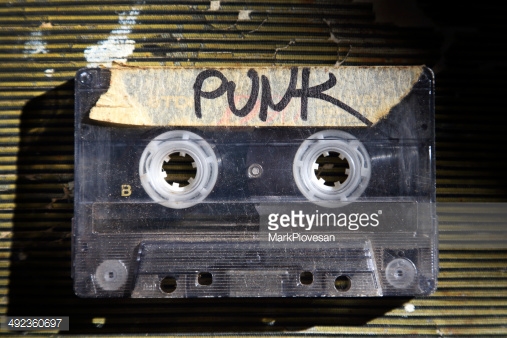
My Awkward Association with Punk Rock Part 1

Like most kids, I grew up listening to Top 40.  I listened to Casey Kasem’s (and later, Rick Dees’) countdown show every Sunday, if I could.  My parents listened to a lot of ABBA and Neil Diamond, so that was always in the peripheral.  That was pretty much how it was through the 5th grade, aside from one blip: some small time college band called R.E.M.

My brother introduced me to R.E.M. for one reason and one reason only: they had a song about Superman.  It would be years before I even realized the song was a cover.

For some reason, once I reached middle school, I started borrowing tapes from my brother (yes, tapes).  There was more R.E.M., of course.  The B-52s.  Depeche Mode.  The Sundays.  They Might Be Giants.  Nine Inch Nails.  Jane’s Addiction.  Mostly “progressive” music that would either become or lead to “alternative” music.

I remember my friends at the time thought everything I listened to was weird.

I entered high school in the fall of 1990.  That first year I mostly continued listening to my weird progressive music.  I was an angsty kid, and at the time it was as close to angsty as I could find (aside from metal, but I didn’t know any metal kids, so it was a complete mystery to me.  My metal phase would come much later).

In the fall of ’92, things changed.  I was still angsty, and suddenly there was music for exactly that emotion: grunge.  For about two years, it was the majority of what I listened to.  I know it sounds stupid, but it spoke to me.  It said the same things I was saying.

In the winter of ’93, I joined a band.  We called ourselves oral groove (yes, lower case).  Our biggest influence was probably Ned’s Atomic Dustbin, although I was clearly trying to be Eddie Vedder, at least for the first year.

Being in a band exposed me to more music (like the aforementioned Ned’s).  Aside from the flavor of the day, we each liked different rock music, from metal to hair bands to hippie jam bands.  None of us really listened to anything that might have been called punk rock, not really, not then.  But we did seem to push each other to find new bands outside the growing alternative mainstream.  The Afghan Whigs and Quicksand were two notable finds.

Grunge was the first cultural phenomenon I got on board with early on, and the first one I watched expand like crazy and ultimately become co-opted.  I’m not saying I wasn’t part of that, but it was strange to watch.  As grunge became alternative, it was watered down, and very quickly third and fourth generation bands were mimicking the same sound.

Alternative music also lacked the angst that grunge had.  It veered into hippie territory.  I was far too disgruntled for that.  I had to look elsewhere.

I can still remember sitting in my parents living room watching the video for “Unsung” on MTV.  Helmet were four dorky guys with short hair playing heavy music and I broke my cassette of their second album, “Meantime” I played it so much.  The last part of my senior year, Helmet had unseated many of the grunge bands.

And then I graduated.

Musically, I took Pearl Jam, Ned’s Atomic Dustbin, R.E.M., Weezer, Helmet, and the Afghan Whigs with me.  Say what you want about Pearl Jam, but they were always the grunge band that got me.  I didn’t have the refined pallet to appreciate Nirvana the way I do now.

I had a good mix going.  Weezer hadn’t really taken off yet, but I bought their first album as soon as I heard “Undone.”  The Afghan Whigs was a band that my friends and I absolutely loved, and that no one else we knew seemed to care about.  It was the same way with Ned’s, although they were more of a pure alternative band.

Two bands happened to me the fall of my freshman year of college that completely changed the way that I thought about music.  Those bands were Jawbox and Sunny Day Real Estate.

Oh, and I also started playing guitar.  Suddenly I was much more involved in creating music, and if mainstream music had turned me off before, it was even worse now.  The lack of integrity in mainstream music became very apparent when I started creating my own.

The final element of my musical awakening, if you will, came from a discovery that was, funny enough, facilitated by the internet.  Back then the internet was, for me, mostly about BBS forums and record label web sites; there were no such things as MP3s.  But internet gave me the information I needed for something very important: mail order records.

Armed with catalogs I’d printed out from web sites, addresses from the same, and a record player I’d had for at least a decade, I began my submersion into the world of underground music.
 

Album Review: “The Living End” by Sarah and the Sundays

A wonderfully sad happy record from Sarah and the Sundays

There used to be a genre of music called “progressive.” It was a precursor to alternative and is often referred to as “college rock.”

Progressive was understated in a way that alternative was over the top. Progressive songs were spacious and minimal. It was rare for a progressive song to have a big sound. It wasn’t so much that it was understated, but unfettered. Part of this was this was because, at the time — the mid to late 80s — technology was still limited. The core of a song had to do all the heavy lifting. Punctuation had to come in the song writing, not in dynamics. The “loud, quiet, loud” paradigm didn’t exist.

A lot of modern indie rock bands have embraced this sounds, this style of writing. It’s hard to pull off because it’s not a matter of making the music sound lo-fi — if anything, some progressive records were over produced — but making them sound organic. Here’s a bunch of people with some instruments sitting in a room and making music, but it’s not folk or country or even bluegrass. There’s still a plugged in sound to it, still an electricity that comes with rock or pop.

Sarah and the Sundays may have made the perfect modern day progressive record with “The Living End.”

Inevitable R.E.M. References

It’s probably not shocking that the band’s popularity has grown after they released their cover of R.E.M.’s “Losing My Religion.” There are certainly similarities to the two bands, from the bluegrass/folk influence to their pop sensibilities. Brendan Whyburn’s guitar sound alone…

But while those early R.E.M. records seem distant, full of abstract ideas and the treading of new ground, Sarah and the Sundays are more specific, in part because they can be. They don’t have to do what R.E.M. did. Their sound isn’t quite so unusual, but that doesn’t make it any less great.

Sarah and the Sundays has a leg up on R.E.M. with regard to that aforementioned pop sensibility, at least compared to R.E.M.’s early days. While both bands can create moody, atmospheric music, Sarah and the Sundays place the hook at the foreground, more so than early R.E.M. did.

Happy Sad Happy

“The Living End” was written during COVID, not long after the band went from being a long distance project to part of the Austin music scene. You’d probably be able to piece together the first part of that based upon the songs, as singer Liam Yorgensen regularly taps into the feelings of sheltering in place.

But the band doesn’t stick to those feelings, even if they reappear throughout the album. They use them as an entry point for other ideas, other experiences. A song like “I’m So Bored” could easily reek of privilege, but it suggests there’s more going on than someone who’s biggest problem is not being able to socialize.

The issue of mental health comes up repeatedly on “The Living End” and, for as effective as it is as a snapshot of the pandemic, it’s perhaps even better as the journal of someone struggling with their own brain. It’s not just a turn of the phrase, either (“here come the chemicals/it’s a bit of a nightmare” from “Coward” or “I’m just a psycho with spare time” from “Vices,” for example); the songs are nothing if not sincere. The music is coming from the band in such an organic way that it doesn’t feel like there’s any distance between the songs and the people.

“Veener” starts off like an aforementioned progressive song, but then drummer Quinn Lane lays down this slow disco beat and we get what is probably the first overt use of vocal effects we hear on the album. But when the chorus kicks in, it’s pure rock, albeit still focused on the hook of the vocals.

The variation could result in something that sounds like an experiment, but the transitions are organic, so it sounds natural.

If their cover “Losing My Religion” is a bit on the nose as far as their influences are concerned, “Miss Mary” is on the ears. It’s impossible to hear Declan Chill’s opening bass line and not think of The Cure. But the song quickly becomes their own, climaxing with the wonderfully catchy chorus: “Do you remember when I said I was moving on/Yeah just forget it/Do you remember how my life just went to shit/because I let it.”

The band also knows the tricky math of how much keyboard is too much keyboard, as Miles Reynolds seem to know exactly which songs need his keys and which need his guitar. “I’m So Bored” lives and dies by a ridiculously hooky keyboard part, but it doesn’t beat you over the head.

It’s hard to pick out just a few stand out songs from “The Living End.” The lounge feel of “Stick Around” is such a mood that it makes this album great by itself. The structure of “Pulling Teeth,” with its dynamic use of a scale, the wonderful 70s rock backing vocals, and the most emotive singing on the record makes it another gem.

It’s hard to find a song that drags or slows this record down at all.

You can get “The Living End” digitally or on vinyl.

There will definitely be a few songs on my 2023 music mix.

Faith No More’s “Angel Dust” is Gloriously Adolescent

I don’t mean that the album is transitional, I mean that the album is the perfect encapsulation of being a teenager, perhaps more specifically a white boy not living in a city.

I would love to think that my teen years were grunge, but that’s probably more the romanticized view than anything else. The reality is that no single record portrayed the overall creep factor of raging hormones than “Angel Dust.” No other album dipped into the inner and outer turmoil the same way, to the same degree. This wasn’t just “I’m lonely and sad and no one will ever love me.” This was “here are all the fucked up things going through my head.”

“Land of Sunshine” comes off as this horrible double edged sword of “congrats, grad!” and “you might be right, you might be insane.” They seem to be such disparate ideas, yet it’s exactly how any weird teenager feels. On one hand, you’re focused on a theoretical future where you might actually feel good about yourself. On the other hand, you regularly feel horrible and you’re pretty sure you shouldn’t, but you can’t help yourself.

Follow that up with “Caffeine” which, among other potent lines, includes: “Relax. It’s just a phase. You’ll grow out of it.” It’s like a fucked up user manual of reassurance. Yes, you are a freak, but it’s cool.

The beauty of “Midlife Crisis” is that it’s exactly the kind of song someone terrified of a theoretical midlife crisis would write. I can remember being a teenager and being terrified that I would end up like my parents who, at the time, were probably experiencing their midlife crisis. In some ways this was the greatest fear that a white kid in the suburbs could have: becoming another suburban parent.

And this leads beautifully into “RV.”

When I listened to this in high school, I thought it was fun, a cool song that was making fun of sad, white trash. Listening to it now, though, I realize how poignant it is, how complex the song is not just lyrically, but musically. What starts off as a caricature becomes a real person by the end, particularly with that last line. It some ways, this is a cautionary tale, a warning that listening to your parents isn’t necessarily a good idea.

While “Smaller and Smaller” instantly conjures images of bugs that will not die, the song itself is something of a rural anthem, a musical take on the plight of the farmer who is slowly being beaten down by the modern world. Again, this record isn’t about the city folk, it’s about those of us in the suburbs and the country.

“Everything’s Ruined” comes back to the idea of family being an investment and parents looking at their children as a way to increase the status of the family name, not to mention the the family fortune. Again, for a kid in the suburbs whose life has been mapped out, this was like heroin. Th song is telling us that if we don’t turn out the way our parents want, they will consider the whole ordeal to have been a waste.

Is “Malpractice” about how horrible it is to try to appeal to the masses? Maybe?

“Kindergarten” is clearly about a kid who is held back in kindergarten, but in this case it seems as if he will never get past kindergarten no matter how old he gets. This is stunted adolescence taken to the next level; this is perpetual childhood, but not in a good way. This is the story of a person who needs to grow up, who wants to grow up, but is unable to move forward. This could very easily be about a teenager, but setting it in a kindergarten makes it substantially more resonant.

Faith No More’s greatest accomplishment could be getting straight teenage boys across the country to sing “I swallow” at the top of their lungs. “Be Aggressive” might be about more than blowjobs, but it would take a better person than I to dig into it.

I played soccer in high school. I was pretty good at it, too. Every year my school had an awards banquet for the sports that played in the fall, which was usually dominated by football. But after the main banquet, the individual sports had their own awards ceremonies. I remember that my brother, who was the assistant coach at the time, told me in confidence that the MVP voting had been a tie between me and another guy, and that we’d likely have to vote again. But that never happened and the head coach gave it to the other guy, apparently because he felt like it. Had I just voted for myself, it would not have been an issue.

Anyway, on my way home that night I listened to “A Small Victory.” At the time, it was mostly for the vague references to sports and competition. Listening to it now, I see that it’s about someone who just cannot win, but at the same time questions why competition is something that drives us. My reading is that, in the end, the continual loser is the one who realizes that this competition is meaningless, but the winner won’t listen to reason.

Sounds about right.

As near as I can tell, “Crack Hitler” is about a drug lord. The lyrics paint a pretty good picture, from setting the song in Miami to the briefcase, the high speed chase, to evil lurking in every person’s heart. Calling the song “Crack Hitler” is certainly sensational, as crack was still destroying communities like the plague and, well, Hitler is Hitler. So if we’re looking for a crossroads of awful both near and far, this is a good one.

The brilliance of “Jizzlobber,” aside from the name, is that it encompasses the entire album.  Again, this is teen angst delivered with a different type of self-loathing that we got from other bands of this time. This is a dirty song with a dirty title and dirty lyrics and we all felt dirty all the damn time when we were teenagers. And this song was Faith No More looking over the 11 other songs on this album and saying “you are disgusting, but we get it.”

Closing the album with a instrumental piece called “Midnight Cowboy” is just about perfect. Aside from the fact that it’s the perfect come down after such an intense album, the reference to “Midnight Cowboy” hammers home a lot of what this album was about. The layered, heavy music over top of the kind of simple melody you would expect to find being performed at a quaint, old world restaurant summarizes the album nicely: we are following a pattern that has always existed and it really is more fucked up than ever.

“Angel Dust” is the perfect teen angst record for a specific demographic and it was more telling than I realized at the time. It’s not the way I wanted to feel or even how I thought I felt, but what I actually experienced every day. And it transforms me back into a teenager every time I hear it.

My Awkward Association with Punk Rock Part 1

My brother versus Top 40

Like most kids, I grew up listening to Top 40.  I listened to Casey Kasem’s (and later, Rick Dees’) countdown show every Sunday, if I could.  My parents listened to a lot of ABBA and Neil Diamond, so that was always in the peripheral.  That was pretty much how it was through the 5th grade, aside from one blip: some small time college band called R.E.M.

My brother introduced me to R.E.M. for one reason and one reason only: they had a song about Superman.  It would be years before I even realized the song was a cover.

For some reason, once I reached middle school, I started borrowing tapes from my brother (yes, tapes). This would have been the late 80s, so perhaps I’d gotten my fill of hair metal and pop music. The songs that were topping the charts just weren’t enough for me; they didn’t speak to me. 

My brother had this cassette rack that must have been made from balsa wood or whatever the next step up in wood was. I remember when I eventually got one, how glorious it was to see this giant wall of tapes. I remember opening a space on the rack when I got a new tape so I can keep them in alphabetical order.

My brother was ahead of his time when it came to music. Like me, he was a white kid from the suburbs, yet my brother had a handful of hip hop albums in his collection, more than anyone else I knew. He got really annoyed when I played him a Vanilla Ice song because Vanilla had swiped a line from Big Daddy Kane (possibly one of the lower offenses Vanilla Ice is guilty of).

The majority of my brother’s collection, though, fell squarely in the “progressive” category. There was more R.E.M., of course.  The B-52s.  Depeche Mode.  The Sundays.  They Might Be Giants.  Nine Inch Nails.  Jane’s Addiction. There were a lot of bands that would be relabeled “alternative” when a similar sound hit the mainstream.

I remember my friends at the time thought everything I listened to was weird. I don’t know that that was part of the draw, but I did like the fact that I didn’t know anyone else that was listening to that kind of music.

Weirdness and angst

I entered high school in the fall of 1990, multiple mix tapes of weird music in hand. I had a lot of thoughts in my head and “progressive” music seemed to be made by people with the same issue. They also played a lot of sad and thoughtful songs, a mood that occupied much of a my time. My angst wasn’t just sadness, though, as I had plenty of anger, and that anger would find a soundtrack with the arrival of grunge.

For a solid two years, the majority of what I listened to was either grunge or grunge adjacent. I was a melodramatic teenager who knew nothing of the various chemical reactions happening (and not happening) in my brain, I just knew that I felt different and the people making grunge music seemed to understand that.

In the winter of ’93, I joined a band.  We called ourselves oral groove (yes, lower case).  Our biggest influence was probably Ned’s Atomic Dustbin, although I was clearly trying to be Eddie Vedder, at least for the first year.

Being in a band exposed me to more music (like the aforementioned Ned’s).  Aside from the flavor of the day, we each liked different rock music, from metal to hair bands to hippie jam bands.  None of us really listened to anything that might have been called punk rock, not really, not then.  But we did seem to push each other to find new bands outside the growing alternative mainstream.  The Afghan Whigs and Quicksand were two notable finds.

Grunge was the first cultural phenomenon I got on board with early on, and the first one I watched expand like crazy and ultimately become co-opted.  I’m not saying I wasn’t part of that, but it was strange to watch.  As grunge became alternative, it was watered down, and very quickly third and fourth generation bands were mimicking a sound that barely resembled the original.

Alternative music also lacked the angst that grunge had.  It veered into hippie territory.  I was far too disgruntled for that, so I had to look elsewhere.

I can still remember sitting in my parents living room watching the video for “Unsung” on MTV.  Helmet were four dorky guys with short hair playing heavy music and I broke my cassette of their second album, “Meantime” I played it so much.  The last part of my senior year, Helmet had unseated many of the grunge bands.

And then I graduated.

Turntable Exiles

Two bands happened to me the fall of my freshman year of college that completely changed the way that I thought about music.  Those bands were Jawbox and Sunny Day Real Estate.

I also started playing guitar.  Suddenly I was much more involved in creating music, and if mainstream music had turned me off before, it was even worse now.  The lack of integrity in mainstream music became very apparent when I started creating my own.

The final element of my musical awakening, if you will, came from a discovery that was, funny enough, facilitated by the internet.  Back then the internet was, for me, mostly about BBS forums and record label web sites; there were no such things as MP3s.  But the internet gave me the information I needed for something very important: mail order records.

It’s impossible to overstate the significance of the mail order business back then, just as it’s probably impossible to explain it to anyone who wasn’t alive then.

You would look over every listing by every record label. They had to sell you in a just a few sentences and the easiest way to do that was by referencing bands you already knew and liked. You’d mark the ones that you wanted, then added up the damage.

Then you’d have to start cutting because you always marked a done of records and you never had enough money. Then finally you’d mail your order form and a check (a check!) or money order and you would wait four to six weeks to get your records.

You had to force yourself to forget that you even ordered them.

But, man, when you got them, it was everything. Indie labels back then had limited ways of promoting themselves. They’re weren’t going to make commercials for TV or radio because that was simply too much money. But they were generous with the freebees. I think most of the music related stickers I ever owned came for free with records I ordered.

So armed with distribution catalogs and a record player I’d had for at least a decade, I began my submersion into the world of underground music. 

More on my punk rock journey in part 2.