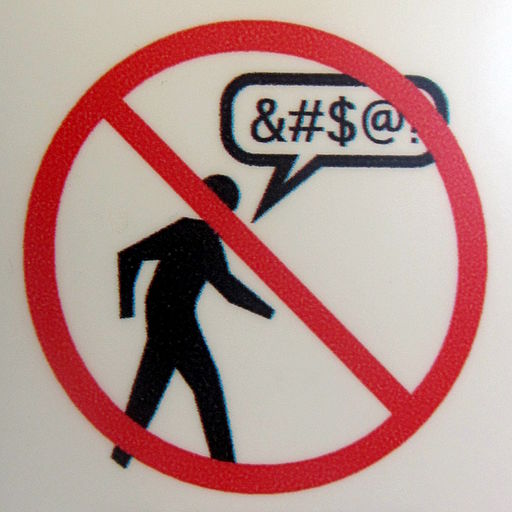
Potty, Swear, Curse: Why do we have bad words?

Our younger son is going through the “potty talk” phase. He adds “butt” and/or “poop” to any sentence. It’s almost a reflex at this point.

We let him do it, although we draw the line at name calling, but that applies beyond “potty talk.”

He is told at school that he can’t say those things.

Sometimes while driving around with our older son, I’ll listen to podcasts. My son doesn’t really notice unless I’m listening to Smartless. The hosts and guests on Smartless — co-host Will Arnett in particular — are very free with their swear words, and it’s usually some form of “fuck.”

My son points it out whenever they say these words. He does so along the lines of “why are they saying mean words?” or “they should stop saying those words.”

This comes from his school, of course. Swear words are a no-no at the elementary school and, really, at most schools, regardless of the grade level.

The fact that we have words that we’re not supposed to use, or that are considered inappropriate to use, has always struck me as bizarre.

Don’t get me wrong, while on the surface I believe a word is a collection of letters, I understand that there’s some context. Words that exist solely to oppress others aren’t words that should get thrown around. There are words for every minority group that have no place coming from the mouths of anyone outside that group, and what those within the group decide to do with those words is up to them.

But those aren’t even considered swear words because it’s common knowledge that they are hateful.

George Carlin did an entire bit on swear words, called “Seven Words You Can Never Say on Television.

This was his thinking, from an interview in 2004 with NPR:

On these other things, we get into the field of hypocrisy. Where you really cannot pin down what these rules they want to enforce are. It’s just impossible to say “this is a blanket rule”. You’ll see some newspapers print “f blank blank k”. Some print “f asterisk asterisk k”. Some put “f blank blank blank“. Some put the word “bleep”. Some put “expletive deleted”. So there’s no real consistent standard. It’s not a science. It’s a notion that they have and it’s superstitious. These words have no power. We give them this power by refusing to be free and easy with them. We give them great power over us. They really, in themselves, have no power. It’s the thrust of the sentence that makes them either good or bad.

I’d would actually got a step further and say that even the thrust of the sentence is irrelevant because there’s a non-swear word version of every swear word. You can say “poop” all you want (unless you’re in pre-school, apparently) but you can’t say “shit,” which is the exact same thing.

I believe that language is malleable and that being able to modify your speech for a specific topic or setting is great. I don’t swear around my grandparents; I swear like a sailor with my friends.

But I think that’s an aesthetic choice. We all pick and choose which words we use, even if its unconscious.

President Obama was often criticized for this, even though it’s something politicians have done for generations — even though it’s something everyone does.

But I come back to the main question: why are some words considered inherently bad, particularly words that have no historical connotations?

Some of the people who police these things also incorrectly site the first amendment whenever they get into trouble for saying horrible things. Your kids can’t say “fuck” but they think the first amendment means it’s okay for them to use the N-word. It’s baffling.

And it’s universal! This belief that certain words aren’t allowed to be said crosses demographic lines.

I have no idea why.

Why does it persist? Even as we see various other socially generated taboos fall, this one hangs on and is seldom questioned.

The more pressing question, is how do I address this with our kids?

As I said, we let the youngest use all the “potty” language he wants, the belief being that it will lose its novelty at some point. It worked that way with our older son. They key is making both of our kids aware that certain words are more appropriate than others depending upon the situation.

The other day at dinner the word “shit” came up. I don’t even remember why. But this was the A plot to the long running B plot in the background, our youngest saying “poop” over and over.

Our oldest mentioned that the s-word was a bad word. I asked him if he knew what shit was.

He did not.

“It’s poop.”

“Then why is it a bad word?”

“That’s a great question.”

Trying to be Superman

My son refers to all superheroes as Superman.

I’m not sure how he knows which characters are superheroes. The Spider-man action figure is Superman. The Batman book features Superman. But Woody from Toy Story is Woody. None of his Duplo figures are Superman. Only the two superheroes get named for the ultimate superhero.

How does he know? Spider-man doesn’t wear a cape. Maybe it’s the fact that they all have symbols on their chests.

I’ve been reading comic books for over thirty years and there’s a lot to be said about the depictions of masculinity in superhero comics, most of it not good. But growing up this was my example, at least on a subconscious level. I’ve noticed recently that there’s an evolution at work within superhero comics, epitomized by what are perhaps the three most iconic characters, who all happen to be male (and white and straight, for that matter): Spider-man, Batman, and Superman.

I realize that those three are not the traditional “trinity” of superhero comics, largely thought of to be the DC trinity of Batman, Superman, and Wonder Woman. And those three aren’t the current Marvel movie trinity of Captain America, Thor, and Iron Man. But I think the average person on the street with only a passing familiarity of comics would point to Spider-man, Batman, and Superman as the top of the hill with regards to superheroes.

Let’s consider 3 aspects of Spider-man, Batman, and Superman: family, violence, and sex.

The classic version of Spider-man (the one who will be gracing movie screens yet again next year) lives with his aunt. She’s a prominent figure in his life. He is still very much in need of parenting. Even today in the comics, he is the only one of these three characters who still has a mother figure in his life. Being someone’s child is still very much who Peter Parker is.

He might be older now, but the iconic Spider-man is a high school kid, so much so that Marvel regularly goes back to that well whenever they can, be it Untold Tales of Spider-man, Ultimate Spider-man, or Spidey.  And any time Peter Parker might start moving too far forward with his life like, say, getting married, Marvel has done whatever it takes to pull him as far back as they can. My favorite Spider-man stories are actually the ones that take place after he’s graduated from high school, but I understand the appeal. High school Spider-man is a way of life. But he’s not a paragon of maturity.

Batman, however, is clearly an adult. While Alfred may seem like a father figure, Bruce Wayne has taken it upon himself to be a father for a handful of characters who more often then not work with him as Robin. Part of what makes Batman more than just a two dimensional vigilante is the fact that he’s trying to build a family to replace the one he lost.

He is, it should be noted, a horrible father, though. It would be easy to make the case that he’s an abusive parent and should never be entrusted with minors.

Bruce Wayne is also over the death of his parents, no matter how many times it’s revisited in the comics. He’s not doing what he does to avenge them, not anymore. He has a mission and he’s devoted his life to it. Was the death of his parents the motivation for that choice? Of course, but it’s moved well past that.

Superman never really had to move past the death of his parents because he was a baby when Krypton was destroyed; he has no memory of them. As to whether Ma and Pa Kent are alive, I’m not entirely sure, as their status in the comics seems to change on a regular basis. The most common scenario seems to be Pa no longer with us, but Ma still alive. Regardless, by the time either or both of his parents die, he’s already been fighting for truth, justice, and the American way for some time; their deaths are not his motivator.

Because here’s the thing: Superman is selfless. Sure, perhaps you can make that claim about Spider-man and Batman, but those two characters regularly struggle with their own needs versus the needs of others. Most of Spider-man’s early stories deal him making the wrong choice in this regard, in part because every time he makes the right choice horrible things happen. And it would be easy to argue that Batman is the most selfish superhero in all of comics, in part because of his martyr complex.

Superman doesn’t really struggle with such things. Superman knows who he is and he’s comfortable in his own skin. He really is what we all aspire to.

The violence these characters take part in (these are superhero comics we’re talking about) reflect the characters perfectly: Spider-man makes jokes while he fights, Batman is painfully serious, and Superman, well, Superman usually tries to resolve conflict without violence if he can. There have been a number of writers over the years who have actually tried to write Superman as a pacifist, but even when he’s not taken to that extreme, violence is his last resort. To an extent, it has to be; he’s so powerful that his actions can have unforeseen consequences. But this is also a reflection of who he is, just as Spider-man’s jokes reflect his insecurity and Batman’s grim determination represent his lack of balance.

Their love interests are equally as telling. Regardless of what comic book lore would tell us, Spider-man has really only had two love interests: Gwen Stacy and Mary Jane. He met both of them while still in high school. Gwen was a two dimensional personification of the girl next door, while Mary Jane was the actual girl next door, who would be come the ultimate adolescent fantasy: a model.

Vicki Vale notwithstanding, Batman’s most notable romantic partners are either villains or those who walk the fine line between villainy and heroics. Batman has a bad girl fetish and it plays perfectly into the next step of maturity from Spider-man. These are women who need a strong man to get them to behave, emphasis on the man. But these aren’t real relationships.

Let’s just get this out of the way, then: Lois Lane is a singular character, unlike any other in all of comics.

Superman isn’t Superman without Lois Lane, so much so that creators in other mediums don’t even pretend it’s possible to separate the two. There was a TV show called Lois and Clark: The New Adventures of Superman that, as is clear from the title, was about the two of them, not just the guy with the S on his chest. Heck, technically she got top billing.

You can separate Batman and Catwoman or Spider-man and Mary Jane, but you can’t separate Superman and Lois Lane.

And she’s done this by being one of the few female characters in superhero comics known for her brains, her wit, and her ability. I honestly can’t remember any lengthy period of time in which Lois Lane was nothing more than a pin-up; the same cannot be said for the vast majority of other love interests.

And perhaps that’s why — Lois Lane has never simply been the love interest. That’s not to say that she was written particularly well in the early years, but her obsession with Superman ultimately translated to tenacity as a reporter that expanded beyond the Man of Steel. Once she found out who Clark Kent really was, nothing changed. She was still the same driven Lois Lane.

The fact that Lois Lane is who Superman falls in love with speaks volumes. And, of course, he marries her, and in current comics continuity, they have a son.

Lois Lane isn’t marrying Batman. She’s not dating Spider-man. She’s spending her life with someone who deserves her.

This is where I am, then: I was Spider-man, then I became Batman, now I’m desperately trying to be Superman.

That’s not to say I was actually any of those characters. But my growth as a straight white guy can be traced from character to character. I still think Batman is the best superhero character in comics, if only because of how he changes to reflect society from decade to decade. But Superman is the be all and end all. He’s who we should all want to grow up to be.

We reminisce about being Spider-man. We fantasize about being Batman. We try to be Superman.

A few months ago, DC Comics (home of Batman and Superman) had a soft relaunch of their comics. One of the biggest changes was replacing a young, single version of Superman with the aforementioned married with child version. Not much was changed about Batman.

The current crop of Batman books do nothing for me.

But Superman is probably my favorite superhero comic currently being published.


Parents: Use your phone as much as you want

As much as it pains me to use the current hip vernacular, I’m going to: parent shaming.

At one point, I think the focus for parent shaming was screen time, as in how much time your child can spend staring at a screen of some kind. But there’s a lot of grey area in the studies on the impact screens have on children. The general consensus is that too much screen time is bad, yes, but different types of screens have different impact. What’s on said screen is also a consideration.

So screens are not as cut and dry as other parent shaming options.

Diet? Sugar is the heroin of toddlers, after all.

Education? The best time to learn a second (or third!) language is at the age of two, you know.

Culture? Listening to an opera would be so much more stimulating than listening to the Cars soundtrack (again).

But, no, those options are somewhat narrowly targeted and, for many parents, easily avoidable. What, then? What is something that every parent does that can be ridiculed by those who wish to feel superior?

Cell phones.

Boom.

You use your cell phone when your child is with you? That is shocking — shocking, I say! Your child is going to think you care more about your cell phone than you do about your own precious little angel!

It is impressive how many parents take to the internet to rail away against the evils of using your cell phone when your child is present, pretending as if they’re doing it to somehow help other parents. I can’t imagine a single parent reads these articles and suddenly changes their ways. No, they’re written so the writer can feel superior.

I know full well how tempting it is to use a device as a baby sitter. I also know that there are other toys which can do roughly the same thing while allowing your child to control the creativity. That said, I don’t begrudge anyone who’s in a position where a device is their best option. I know too many single parents to think that a tablet can’t be a life saver.

But let’s get back to parents using cell phones.

I understand the basic concept behind the complaint, the idea that kids will think that they are less deserving of your attention because you are looking at your phone all the time. But consider that thought. Think about how much the average parent has to do with their child over the course of any given day. It would be physically impossible to spend more time on your device than interacting with your child. They are tiny tyrants who need you to survive. A cell phone isn’t going to dress them or take them to school or get them to bed. A cell phone isn’t going to comfort them when they get hurt or help them through some strong emotions. We have few moments that aren’t controlled by these kids and very, very few of those moments can be solved by cell phones.

So if your kid is playing and you decide to check Facebook, where, exactly, is the harm? If your child needs you, you’re there. But your child doesn’t always need you and, honestly, it’s probably good for them to realize that. “Hey, child of mine, you’re doing fine on your own and I trust that you can scoop sand into a bucket without me watching you like a hawk, so you do your thing, I’ll be right over here if you need me.”

The crazy thing about it is that if there’s another parent shaming method out there, it’s the “helicopter parent” who is always hovering around their child, never letting the kid do things on their own.

So if it’s bad for us to follow our kids around and obsess over them and it’s bad for us to do other things while we’re with our kids, then what, exactly, are we supposed to do?

I am overly sensitive about my son knowing how much he means to me. I tell him constantly. It’s a whole thing. So at some point early on in his life I decided that if I’m going to use my smart phone around him, I’m going to tell him why I’m doing it. I want him to understand why looking at this tiny screen would be something I would want to do while he’s eating dinner or or watching cartoons.

So I say things like “let’s see if mama has left work yet” or “let’s see what the weather is going to be like” or “grandma sent me a message.” I try to explain what social media is, but he does’t seem to care. In fact, he doesn’t really care about any of that, but I feel like telling him what I’m doing at least helps him realize that there’s a purpose, that I’m not just looking at my phone for no reason.

I explained this to a therapist who works with children and she told me it was genius, so I’m running with it.

Here’s the thing: being a parent is hard. I realize that’s like complaining that your diamond shoes are too tight, but it is what it is. And sometimes you can only take so much Paw Patrol or so much doing funny voices before you need a break, and in today’s day and age, a break is looking at your phone. And I don’t think there’s anything wrong with that.

So for those who are thinking about telling other parents they need to stop using their phones so much around their children: don’t. Get off your high horse and just let a fellow parent be. We are all stumbling through this together and the last thing any of us needs is someone giving us shit for looking at Facebook while our kid is crashing cars into each other.

Go to town, parents. Use your phones as much as you want. I don’t have the answers for that and I’m not stupid enough to think that I do.

Discovering Hip Hop at 40

I wrote this eight years ago and I’m still discovering hip hop

Having kids leads to some strange changes in your life.

Like listening to hip hop.

I was born in the mid-70s, so suggesting that I’m a child of the 80s wouldn’t be far off. But puberty wrecked havoc on me, to the point that I became almost a different person. At the very least, I went from a kid who generally did what he was told to a kid who generally tried to do his own thing. By this token, the 80s weren’t so much my decade as the 90s, after puberty, after I’d decided to start making decisions for myself.

Rap music “broke” in the 90s, really. It had been bubbling below the surface of mainstream music for years, but it really broke through in the 90s. That’s when it became popular music. And even now, I have some affection for 90s hip hop.

But that wasn’t me. I was an angry white kid from the suburbs who had no idea why he was angry and seemingly out of no where came an entire genre of music that spoke to me: grunge. And when grunge burned away, I’d already jumped ship to its main influence, punk rock. And punk rock led me to indie rock, which more or less allowed me to mix some sadness in with my anger.

I stayed away from hip hop. I needed music that spoke to me, but I was also for anti everything, which meant that listening to popular music was out of the question. And, like I said, rap had taken over the Top 40.

I dabbled in hip hop over the years. At a certain point, indie rock began embracing lesser known rap acts, I suppose the way that Anthrax embraced Public Enemy. And I liked hip hop. I’ve just never had any idea where to begin with it and, really, no motivation to do so. I was waist deep in minor chords and feelings and adding another style of music to the mix was just too much for me.

But when you have kids, you suddenly find motivation for things, motivation that wasn’t there before.

I started listening to hip hop regularly after our son was born. The internet is great for getting suggestions; there are a hundred streaming music services that will take one song you like and turn it into an entire playlist. So slowly but surely, I waded deeper and deeper into the hip hop waters.

I’m still a novice, I fully admit that, and I doubt anyone would ever accuse me of being anything other than a dabbler. But I’m open to anything. I want to learn.

What does this have to do with my son?

I wasn’t raised on music. My parents loved Abba and Neil Diamond, but beyond that they seldom even talked about music. When I discovered the Beatles, I raided my parents record collection, but I’d never heard of them from my parents and was surprised to find those albums in the house.

I want my son to be exposed to as much as possible. I know that hip hop might seem like a small thing, but I feel like it’s important. I feel like growing up around a diversity of music is important.

It’s more than that. We live in the Bay area and his class at school is fairly diverse. But I know how much more impact parents can have on kids and I don’t want him to see me living on a steady diet of sameness. I want him to experience a wider world that I only ever got glimpses of and I at least want him to feel like that experience is encouraged, not just overtly.

Honestly, it’s been a lot of fun to dig into a new genre of music, particularly something that’s so far removed from what I’ve listened to for most of my life. It’s like learning a new language. I’m starting to become discerning, starting to notice what I like about particularly songs and what I don’t. I can’t really verbalize it yet, but I’ll get there.

And I still can’t dance, but my son doesn’t care.

What I said when my son asked me what make-up was

When our older son was 3, he asked me what make-up was.

I stopped myself.

I almost answered with the first thing that came into my head, but made a change before anything came out of my mouth. That change was not using the word “women.”

I’m assuming he heard the term “make-up” from my wife, probably that morning as she was getting ready for work, which meant he had to ask me about it on the way to school. So, of course, my wife was on my mind when I started to answer. But I managed to modify my answer before it came out of my mouth.

“Make-up is something people put on their face to make it look different,” was my answer, or at least as close to it as I can remember.

“Do you remember that clip we saw of the boy whose face was made to look like Rubble? That was make-up.”

Rubble is a member of the Paw Patrol and the clip was on the Nick, Jr. app. It was a short video of a make-up artist painting the boy to look like Rubble, a dog.

It’s a legitimate question to ask why I stopped myself. At the time, it was because I don’t want my son to grow up assuming that only women can wear make-up. I don’t honestly know any men that wear make-up, but I know they exist and I don’t want my son thinking of them any differently.

But afterwards, I realized that I was more concerned about the idea of teaching him that women wear make-up. Yes, women can wear make-up, just like men can wear make-up, but they don’t HAVE to. I mean, socially speaking they do which is a problem, but I want him to know that it’s not something he should assume.

I realize, of course, that his 3 year old brain will probably not hold on to my explanation. And, really, my answer was less for him than for me. It forced me to think about the answer.

I’m trying my hardest not to instill in him the same assumptions that were introduced to me growing up. To say that my father was opinionated would be an understatement, but I know I have that within me, too. I have very strong opinions and I’m not shy about sharing them. But I don’t want to put any of that on my son. I want him to walk into the world with as few preconceived notions as possible.

I’m left wondering how often such issues are going to come up (frequently) and how well I’m going to deal with them. I caught myself this time, but what if I don’t the next?

Which is, I think, why it’s important that I did catch myself this time, even though my son is only three. This is practice. This is preparation for the coming years when he takes my comments to heart, when my opinions start to influence his way of thinking.

I think the fact that I’m thinking about any of this at all is a good sign.

Micro-inclusiveness: Raising a white boy

I wrote this five years ago. Since then, we’ve had another son, and his experiences have been very similar.

My son is four. He is as white as they come.

His current cartoon fixation is Handy Manny. He’s watched roughly 8 episodes and so far we’ve mostly talked about the fact that Manny and his friends can speak two languages and I try to translate for him in a more deliberate way than they do on the show. Fortunately for both of us, my Spanish covers everything Manny and his friends say.

My son thinks it’s cool that they speak two languages and has said he’d like to learn Spanish. But, you know, he’s four, so we’ll see how that goes.

It helps that he goes to a diverse school. His former best friend was from France and spoke both French and English. He moved away a few months ago and one of his other friends has now stepped into the “best friend” position. He’s Chinese American and speaks English and Mandarin. For my son, speaking two languages isn’t unusual.

He has two other friends that he plays with every day at school. One is a Chinese-American girl, the other an Iranian-American boy. There were probably a half dozen different languages being spoken at the latter’s last birthday party.

This afternoon my son diverged from his Handy Manny fixation and asked to watch something else: Doc McStuffins.

You don’t need me to go on and on about Doc McStuffins. Here’s a decent overview, although even the accolades list doesn’t do it justice. You can check out what Common Sense Media has to say, too, as they are usually pretty good about these things. Neither of those links really drives home how important Doc McStuffins is and how essential it has become.

More to the point, Doc is a black girl, just as Manny is a hispanic man. They are the main characters on their shows. They are not sidekicks, they are not punching bags. They are kind, nice, genuine problem solvers who happen to not be white.

I know that none of this is huge. I know that I can’t suddenly claim that my son will treat every one equally when he’s an adult because I don’t have a crystal ball. I can’t specifically tell you what kind of impact these shows are having on him, or even the impact of the fact that he has friends who aren’t all just like him. I don’t know how any of this works.

But I know that I grew up surrounded by white people, watching cartoons about white people, and while I don’t think I am ever consciously prejudiced, I have no doubt that I am guilty of microagressions that I’m not even aware of. I also know that I spent most of my life being completely clueless about anyone who didn’t look like me and even though that’s changed over the last decade or so, I still feel like I missed out on a lot before that.

I think this is how it starts, though. I think watching cartoons with diverse characters is how it starts. Going to a school with diverse students is a start. Being raised by parents who are aware of how important this is is a start.

I think the goal of every parent is for their child to grow up to be better than they were.

In that case, this is definitely a good start.

The key is making sure that continues.

Daycare is killing me.

I wrote this 9 years ago when our first son had begun going to daycare.

When I first started writing about him online, I called him Appleseed. We’d spent months reading those “at this month of your pregnancy your baby is the size of a” articles and for some reason him being the size of an apple seed had stuck with us.

He smells different.

At the end of the day, Appleseed smells like the daycare.  It’s similar to how an airplane or a hotel room smells, that attempt to make something sanitized that will never ever be sanitized.  I smell it when I kiss his head.  He doesn’t smell like us.

I don’t think Nicole has noticed because I’ve done a good job of re-scenting him before she gets home.  I sit on the couch with him and give him Sophie the Giraffe, which he promptly sticks in his mouth and gums like crazy.  He slobbers everywhere.  I kiss his cheeks, his head, the spot where his neck and his head connect which makes him squeal with happiness.

The squeal is muted.  There’s less energy to it.  His smiles don’t come as quickly.  His giggles are harder to come by.  And he smells different.

There’s a logical explanation for it.  Besides the sensory overload, Appleseed doesn’t sleep at daycare, not like he should.  They can rock him to sleep, but he wakes up when they try to put him in the crib.  So when I pick him up, he’s tired, too tired to humor his father.  After I’ve gotten my fill of drowning him with affection, I decide to rock him to sleep.  It doesn’t take long.

The best way to make sure Appleseed will not just sleep, but sleep for a long period of time, is to sleep with him.  So I take him into our bedroom, lie him on the bed, crawl in next to him, and tip him over on to his side.  He likes to sleep on his side, he just can’t maintain it on his own.  We’ll spend the next two hours or so like this.

It’s during this time that the smell fades.  Cuddled up in bed, cuddled up next to daddy, he begins to smell like us again.

After the long nap, he starts to perk up.  His energy returns.  And mommy comes home.  The smiles come fast and furious.  The giggles and squeals are back.  Appleseed has returned.

I know that he’s fine at daycare but that doesn’t mean I like it.  That doesn’t mean I don’t feel like simultaneously throwing up and crying when I drop him off, and that’s after I make it out the door.  Up until

that point, I feel like taking him back home and skipping work.

He’s in the infant room at his daycare, and the teacher to student ratio maxes out at 4-1, although it’s probably more reasonable to say 3-1, as one of them is almost always asleep.  But between diapers, bottles, and tantrums, how much attention can those three really get?

When I drop Appleseed off in the morning, I put him in a boppy and I find him a couple of toys.  That’s how I leave him and it has, so far, been how I’ve found him when I come back.  It’s a different boppy and they are different toys, but that’s where he is, because he’s a relaxed baby who can hang out like that.

And that’s perfectly fine.  I know he screams his head off when they change him or when they put him in a crib.  I know he’s happier on the boppy and he’s certainly more quiet.

When I show up, he smiles, he squeals, and he kicks his arms and legs around, so I know he’s happy to see me.  I know he’s still him.  I know he’s fine.

But I want him to be more than that.

Staying at home with Appleseed was exhausting, and I only had to do it three days a week.  It took so much energy to stay engaged with him and I’ll admit that I took a fair number of breaks.  When four o’clock rolled around, it was time to watch a little bit of baseball.  He’d zone out on it for a few minutes, but then get bored.  But those few minutes were nice.

But I did my best, as I know Nicole did.  She felt even more pressure than me, I think, to interact with Appleseed every minute he was awake.  A lot of that is because of how much stuff she reads on the internet.

Our son his happy and energetic to the point where I’m a bit confused by it.  I don’t think we do anything special.  We just love the heck out of him to an obnoxious degree.  And, apparently, he responds to that.

Going to daycare means he’s no longer getting that as much as he used to, and that makes me sad.

It’s hard for me to think about Appleseed when he’s at daycare because it breaks my heart.  I sometimes have to force myself not to think about him because it’s honestly too much.  And I resent the fact that I have to stop myself from thinking about my son.

For the first three weeks of daycare, Appleseed will only be there 3 days a week.  After that, he’ll be full time, Monday through Friday, 8:30 AM to 6:00 PM, although as the guy who picks him up, I can guarantee you he’ll never stay that late.  I’ll be skipping out of work early a lot more often.

I can’t imagine what it will be like when he’s there every weekday.  It seems unbearable.

So the wheels are turning.  Maybe we can handle three days a week and maybe that’s all we need to handle.  I just need to find a way to only work three days during the week.

Because I don’t want him to be “fine.”  I don’t want him to get the bare minimum of attention.  I want him to have all the things he’s had for the last 5 months.

He deserves all that and more.

What is ADHD Part 1: Not what you think

“You don’t act like you have ADHD.”

Our older son has ADHD. He had numerous assessments done and they all got the same results. The fact that I have ADHD really only helped us know what the signs are.

He recently started a camp with a teacher he hadn’t seen in a few years. He mentioned to her that he has ADHD.

She was surprised because he didn’t act like he had ADHD.

She’s a perfectly nice person and she’s not alone. Since the 1980s, a false image has been cultivated of what ADHD is, but I suppose every “new” phenomenon is misrepresented at first.

Look at climate change. People jumped all over the idea of “global warming” without the slightest concept of what that actually meant. But it was an easy way to digest it and, more importantly, it was an easy way to “disprove” and mock it. Record lows? Then there’s no global warming! But, you know, that’s not at all how that works or what global warming means.

So it was with what was originally called ADD, then ADHD. Attention Deficit Disorder, then Attention Deficit Hyperactivity Disorder. The addition of the H actually made the situation worse, not better. It only served to play up the stereotypes and falsehoods of what someone with ADHD is like or, more important, what someone WITHOUT ADHD is like.

Hey, you can sit still for more than two minutes, there’s no way you have ADHD!

The acronym in and of itself isn’t the problem so much as how little people know about the words that make up those letters.

Worse, ADHD came to prominence as it was being diagnosed in children, whose baseline for things like attention and activity is all over the place until they get older.

It’s more accurate to call ADHD Executive Function Deficit, although there are a number of neurodevelopmental disorders that can fall under that. But that’s what ADHD affects: executive functioning, the systems of the brain that manage the cognitive process. Basically, ADHD causes you to think differently than most people.

That kid vibrating in his seat? It’s entirely possible that they do NOT have ADHD. That kid staring out the window during class? They might not have it, either. That kid raising their hand to answer every question? That kid might actually have it.

The quiet kid? AHDH. The loud kid? Maybe not.

The specific aspect of executive function that ADHD impacts has to do with dopamine.

Most people know dopamine as the all natural feel good drug, but it’s impact isn’t always that overt. Dopamine influences the decisions you make, the tasks you take on, the effort you put in. The average person would never think that “lazy” could be a term used to (inaccurately) describe someone with ADHD, but that’s often the case. For people with ADHD, the simplest task can seem like the worst thing in the world.

Dopamine!

Does that kid really, really like answering math questions? Not only will ADHD let that kid answer away, but will, in fact, increase the amount of effort the kid puts into answering math questions. If answering math questions gives the kid a boost of dopamine, then ADHD says “answer ALL the questions so we get more!”

The problem is that since those of us with ADHD operate from a dopamine deficit. Something that would motivate others, something that would make them happy, might not appeal to us at all, or even might repel us.

All of that is to say that the “signs” most people attribute to ADHD are bunk. It also means the stereotype of a person with ADHD is bunk. It’s also a huge problem.

I didn’t get assessed for ADHD until I was in my 40s and even then it wasn’t my idea. My wife had been talking to her therapist about me and her therapist suggested that I might want to get checked out. Since I’m not so dumb as to ignore my wife — particularly when it regards something that could make our life together better — so I got checked out. And, lo and behold, my psychiatrist was like “um, yes, you have ADHD, without question you have it.”

After being diagnosed and learning more about it, I can tell with certainty that I’ve had ADHD my entire life. It’s clear as day to me.

So why didn’t I ever get checked out before?

See everything I’ve written above. I didn’t have any of stereotypical characteristics of someone with ADHD because those stereotypes are wrong. If it weren’t for all the misinformation about ADHD, I might have gotten tested far sooner in life. Even if my parents hadn’t pieced it together, I might have, which means there was a good 20+ years I could have been doing something about it.

Would we have even considered ADHD as a possibility for our older son if a) I didn’t have it and b) we weren’t extremely well read on the subject? I don’t know and the idea that we might have left one of our son’s major needs unaddressed out of ignorance and a belief in the popular narrative just hurts my soul.

You hear “climate change” far more than “global warming” these days.

Someone tell Al Gore we need a documentary.

Boys Are Rough, Right, Dada?

The other day my wife wasn’t feeling well so she stayed home from work. Our son noticed this, of course, and asked me about it. I told him that mama would be home when he got home from school, but that she wasn’t feeling well.

“I have to be gentle with her,” he said. “I’ll get all of my energy out at school so I only have slow energy when I come home.”

“Yes, always gentle with mama,” I said.

My son and I have established some boundaries with regards to rough housing. He’s four, after all, so he’s still figuring out the physicality of life. He wants to wrestle. He wants to run and jump and throw and hit. My wife is not a fan of this, but I love it. A big part of my relationship with my son involves physical interaction.

“I have to be gentle with mama,” he said, “but I can be rough with dada – because we’re boys, right dada? Boys are rough.”

It’s not often than you are aware of moments like this when they happen, but I knew this was important.

I would imagine that if I had said what my dad did when I was his age, the answer I would have gotten would have been “yes.”

I told my wife about it after the fact.

“Did you tell him that girls can be rough, too?” she said.

That’s a totally legitimate response and would have been a good answer.

That’s not what I opened with, though.

“You shouldn’t be rough with anyone unless they tell you it’s okay.”

That’s how I started.

“Daddy tells you it’s okay and mommy says it’s not. Boys and girls can both be rough, but only if they tell you they are okay with it.”

I decided to address consent first, which I suppose is the kind of thing that a guy would do. Maybe I should have started with sexism, but I felt like saying “girls can be rough, too” was letting a genie out of a bottle that I couldn’t pull back.

It would be like saying “you can burn lots of different things, but don’t do it!” I think it was important to establish that being rough with anyone without their consent was bad and then to point out that girls can be just as rough as boys.

Did I address the issue correctly? I have no idea. Will this one conversation with my four year old determine whether or not he respects boundaries as he grows up? Probably not. But it was good to lay the groundwork.

More importantly, it was good to introduce the subject, more so for me than for him, because it’s not going to go away.

Honestly, I’ve spent enough time around little kids to know that boys being rough is the rule, not the exception, while girls being rough is the exception, not the rule. But the goal is to consider everyone, not just rules and not just exceptions.

It was my first swing and I think I made decent contact. At the very least, it’s a start.

Positive Parenting From Negative Parents

The other day I was talking to a friend of mine about our respective childhoods, comparing notes, in a way. While our upbringings were very different, they were thematically the same. Our motivation to do good — or to not do bad — was the same: fear.

Fear is fear is fear. Whether it stems from years being locked under a staircase or the sting of a belt or fabricated stories about people who will harm you, fear is fear is fear. There may be other problems that stem from the impetus for that fear, but that feeling itself is the same no matter where it comes from.

Entire generations of adults were raised through fear, through negativity.

My hometown has trick or treating on the Sunday closest to Halloween during the day. Everyone I have ever met from anywhere else in the country has been confused by this. But in 1981 a boy named Adam Walsh was kidnapped and murdered and kids going door to door at night was no longer considered safe, so my hometown decided to take precautions.

Part of it was the times; we were all prepared for nuclear war at any moment. Part of it was that the generations before us were raised with a very strict set of rules. But at some point the best way to get children to behave was through fear.

More often than not, it worked. I’ve led a pretty responsible life. I passed on a lot of chances because I was afraid of what could possibly happen, but I never got into much trouble.

There are, ultimately, two ways to motivate people: through negativity or through positivity. Negativity will get faster results and is much easier, but usually has unintended side effects. Positivity can take much, much longer, but the side effects are things like self-esteem and confidence. So it’s probably worth the extra time and effort.

And not to sound like a hippy, but positivity is always the best course of action. Positivity will ultimately get the best out of people.

I think my generation realized that at some point. I think we decided that we needed to raise our children in a different way. We decided to try positivity.

The problem is that none of us really speaks that language.

You then get a generation of parents who were raised on negativity trying to raise their children on positivity yet lacking the necessary skills to do so. More often than not, if we mess up it will be in overcompensating.

And this is how we get to endless internet articles on spoiled, entitled children and helicopter parents. This is how we get to mindless jokes about participation trophies (which have actually been around for 50 years, but we didn’t have the internet then).

We don’t want our children to live in fear so we do whatever we can to prevent that, even if we end up making mistakes in the other direction – as we should. Because you know what the world will take away from you? Self-esteem. Confidence. Naivete. You know it will give you? Fear. Humility.

Shrinking an ego is infinitely easier than growing one.

I understand that we run the risk of raising a generation of spoiled, entitled jerks, but I think that’s a chance we should take. Fear is the great enemy. Fear is the source of our misery. We have to do something.

For my part, I ask a lot of questions and read a lot of articles. I look for advice from people who know better. And perhaps that’s the lesson: we really can’t do this alone.

Each generation has the opportunity to do better for the next. That’s not a chance that any of us should waste.